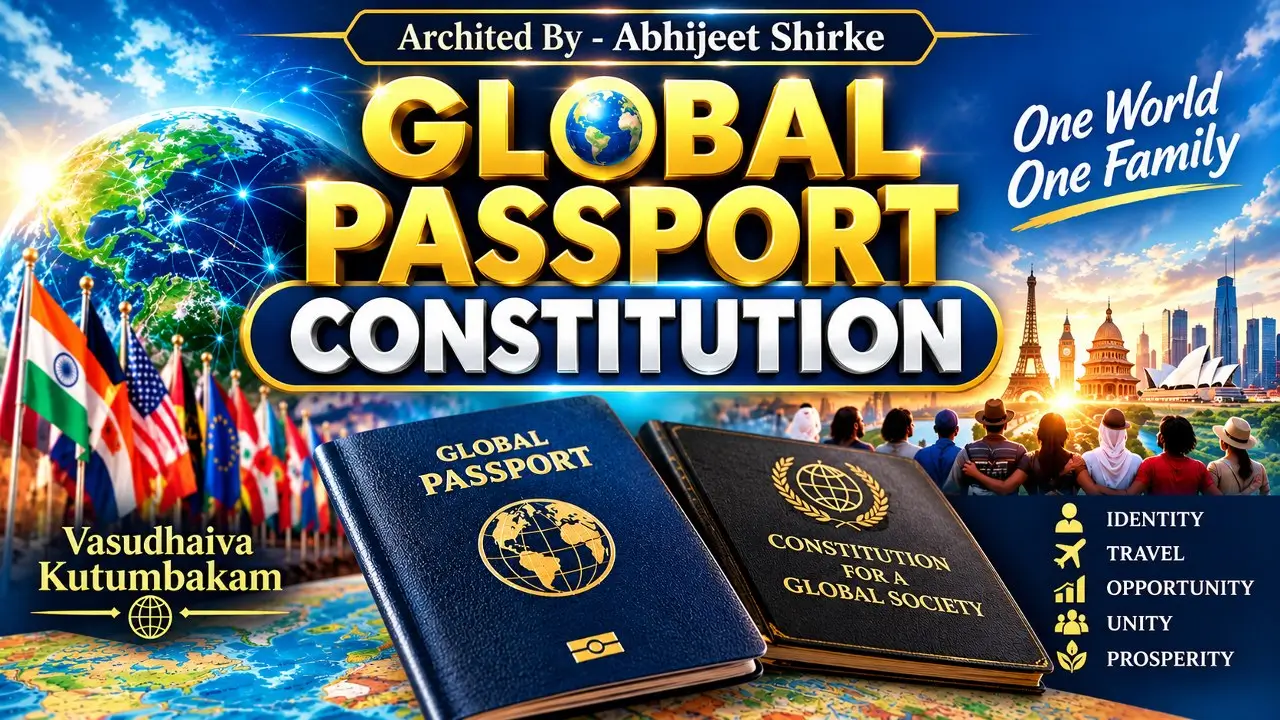
Preamble
We, the people of Earth, united by our shared humanity, interconnected destinies, and collective aspiration for peace, dignity, and progress, do hereby envision and establish a universal framework that transcends borders, barriers, and divisions. In recognition of the fundamental truth that all human beings are members of one global family, we affirm the guiding principle of “One World – One Family – One Future”, inspired by the timeless wisdom of Vasudhaiva Kutumbakam, which proclaims that the entire world is one interconnected household.
For centuries, humanity has been divided by artificial boundaries, lines drawn across maps that have defined nations, identities, and access to opportunity. While these structures have served historical purposes, they have also created limitations: restrictions on movement, inequalities in mobility, inefficiencies in governance, and barriers to global cooperation. In an era defined by rapid technological advancement, global interdependence, and shared challenges such as climate change, economic disparity, and security threats, the need for a unified and efficient identity and mobility system has become essential.
This Constitution on Global Passport System emerges as a transformative response to these realities. It seeks to redefine the concept of identity, not as something confined within national borders, but as a universal recognition of an individual’s existence, rights, and responsibilities within the global community. It establishes the Global Passport as the highest and most authoritative identity document, designed to serve as a secure, inclusive, and technologically advanced instrument for seamless human mobility and participation in global systems.
At its core, this framework is built upon the belief that freedom of movement is a fundamental human right. The ability to travel, explore, connect, and contribute across borders should not be limited by geography, economic status, or political constraints. By enabling visa-free travel across all regions of the world, this system eliminates bureaucratic complexities and inefficiencies that have long hindered global mobility. It replaces outdated processes with intelligent, automated, and secure mechanisms that ensure both ease of access and the highest standards of safety.
This Constitution recognizes that identity in the modern world must be dynamic, secure, and verifiable. Therefore, the Global Passport is designed as a comprehensive digital identity system, integrating advanced biometric technologies such as facial recognition, fingerprint scanning, retina identification, voice authentication, and speech recognition. These systems ensure that every individual’s identity is uniquely verified, protected, and accessible across all global platforms. The inclusion of essential personal attributes, such as blood group identification and family lineage mapping, further enhances the utility of the system in areas such as healthcare, emergency response, and social connectivity.
In establishing this framework, we also acknowledge the importance of harmonizing existing national systems with the global structure. The transition toward a unified Global Passport system is envisioned as a collaborative and inclusive process, where current government-issued passports and identity databases are securely integrated into a global registry. This approach respects the sovereignty of nations while enabling a higher level of coordination and interoperability. It ensures that no individual is excluded and that the transition is smooth, transparent, and equitable for all.
The governance of this system is entrusted to a unified global authority operating under the principles of fairness, transparency, accountability, and inclusivity. This governing body is responsible for ensuring that the system operates efficiently, securely, and ethically, with a strong emphasis on protecting individual privacy and data rights. It establishes global standards for identity verification, data management, and service delivery, ensuring consistency and reliability across all regions.
Accessibility and inclusivity are central to this vision. The Global Passport system is supported by an extensive network of service centers strategically located to serve populations efficiently, including urban and rural areas, educational institutions, transportation hubs, and digital platforms. These centers operate continuously, supported by advanced technological infrastructure, ensuring that services are available to all individuals at all times. The commitment to a maximum processing time of seven days for issuance and renewal reflects the system’s dedication to efficiency and responsiveness.
Financial inclusivity is also a key component of this framework. By standardizing passport fees globally and enabling multiple payment options, including digital wallets, global payment systems, and emerging financial technologies, the system ensures that access to identity and mobility is not restricted by economic barriers. Subsidies and support mechanisms further ensure that individuals from all socio-economic backgrounds can participate fully in the global ecosystem.
This Constitution also integrates environmental responsibility into its foundation. Recognizing the urgent need to address global warming and environmental degradation, the Global Passport system aligns with sustainability goals by incorporating digital processes, reducing reliance on physical documentation, and integrating with global carbon tracking mechanisms. By linking travel data with environmental systems such as a World Carbon Bank, it promotes awareness and accountability, encouraging sustainable practices and contributing to global climate solutions.
Security remains a cornerstone of this framework. In a world where threats are increasingly complex and interconnected, the Global Passport system employs advanced technologies and global cooperation to ensure safety and trust. Multi-layered biometric authentication, real-time monitoring, and integrated intelligence systems work together to prevent fraud, identity theft, and unauthorized access. At the same time, the system upholds the highest standards of ethical governance, ensuring that security measures do not compromise individual freedoms or rights.
This Constitution also looks toward the future, embracing innovation and adaptability as essential principles. As technology evolves, the Global Passport system is designed to integrate new advancements, expanding its capabilities and applications. From linking with healthcare and education systems to enabling participation in global economic platforms, the passport becomes more than an identity document, it becomes a gateway to full participation in the global society. The vision extends even beyond Earth, anticipating the future of human exploration and the need for identity systems that can operate across new frontiers.
Above all, this framework represents a commitment to unity, cooperation, and shared progress. It is not merely a technological or administrative system, but a reflection of a broader transformation in how humanity understands itself and its place in the world. By removing barriers, enhancing connectivity, and promoting equality, the Global Passport system lays the foundation for a more inclusive, peaceful, and prosperous global society.
In adopting this Constitution, we affirm our collective responsibility to build a world where identity is universal, mobility is free, and opportunity is accessible to all. We commit to upholding the principles of justice, dignity, and sustainability, ensuring that the benefits of this system are shared equitably among all people. We recognize that the success of this vision depends on cooperation, trust, and a shared commitment to the common good.
Thus, with a spirit of unity and a vision for the future, we establish this Constitution on Global Passport System as a foundational step toward a truly interconnected world, where every individual is recognized, every journey is enabled, and humanity moves forward together as one global family.
Section 1: Foundational Principles
Article 1. The Global Passport as the Primary Universal Identity Document
Article 1 serves as the cornerstone of the Global Passport Constitution by establishing the Global Passport as the primary universal identity document for all citizens of Earth. This article introduces a transformative shift in how identity is defined, verified, and recognized across the world. It moves beyond fragmented national systems toward a single, unified global identity framework that reflects the reality of an interconnected and interdependent human civilization.
In the current global landscape, identity is divided across multiple systems, passports, national IDs, driver’s licenses, and various regional documents, each with different standards, levels of security, and recognition. These inconsistencies create inefficiencies, delays, and barriers in areas such as international travel, financial inclusion, governance, and access to services. Article 1 addresses these challenges by creating a universally accepted identity standard, ensuring that every individual is recognized equally, regardless of nationality or geographic location.
By declaring the Global Passport as the primary identity document, this article gives it the highest level of authority and trust. It becomes the definitive proof of identity in all contexts, travel, legal systems, healthcare, education, banking, and digital platforms. This eliminates the need for multiple identification documents and reduces the risk of identity mismatches or fraud. Governments, institutions, and organizations worldwide can rely on a single verified source of identity, enabling faster and more efficient processes.
A defining feature of the Global Passport is its integration of advanced digital and biometric technologies. Unlike traditional documents, which can be lost, forged, or misused, the Global Passport is designed as a secure digital identity ecosystem. It incorporates facial recognition, fingerprint authentication, retina scanning, and voice recognition, ensuring that identity is uniquely tied to the individual. These technologies create a multi-layered verification system, making identity theft or duplication extremely difficult. As a result, the Global Passport becomes one of the most secure identity systems ever developed.
The article also emphasizes the concept of portability and accessibility. The Global Passport is not limited to a physical booklet; it exists as a digital identity that can be accessed through secure platforms such as mobile applications, biometric scanners, and cloud-based systems. This ensures that individuals can verify their identity anytime, anywhere, without dependence on physical documents. In situations where a passport is lost or damaged, the digital identity remains intact, allowing uninterrupted access to services and travel.
Another critical dimension of Article 1 is its role in promoting global equality and inclusion. Millions of people around the world currently lack formal identification, which restricts their access to essential services such as healthcare, education, and financial systems. By providing a universal identity to every individual, the Global Passport ensures that no one is excluded from the global ecosystem. It empowers individuals with recognition, dignity, and the ability to participate fully in society.
From a mobility perspective, this article lays the foundation for visa-free and seamless global travel. As the primary identity document, the Global Passport enables automated border control systems where identity verification is instantaneous. Travelers no longer need to navigate complex visa processes or carry multiple documents. Instead, their identity is verified through secure biometric systems, significantly reducing waiting times and administrative burdens. This creates a truly hassle-free travel experience, aligning with the broader vision of a borderless world.
The implementation of Article 1 also requires integration with existing national identity systems. Rather than replacing current systems abruptly, the Global Passport framework is designed to incorporate and harmonize them into a global registry. Verified data from national governments is securely linked to the Global Passport, ensuring continuity and trust during the transition. This collaborative approach respects national structures while enabling global interoperability.
Furthermore, the Global Passport acts as a gateway to multiple global systems. It can be linked to healthcare records, educational credentials, financial accounts, and even environmental data such as carbon footprints. This interconnected functionality transforms the passport from a simple identity document into a comprehensive digital identity platform, supporting a wide range of services and applications.
In essence, Article 1 establishes the foundation of a new global identity paradigm. It creates a system where identity is universal, secure, and accessible, enabling individuals to move freely, access opportunities, and participate in a unified global society. By making the Global Passport the primary identity document, this article removes barriers, enhances trust, and builds the infrastructure for a future where humanity operates as one interconnected family under a shared identity system.
Article 2. Governance Under the Principle of One World – One Family – One Future
Article 2 establishes the philosophical and ethical foundation of the Global Passport system by declaring that it shall be governed under the principle of One World – One Family – One Future. This guiding vision transforms the system from a purely administrative or technological framework into a civilizational model of unity, cooperation, and shared destiny. It recognizes that humanity, despite its diversity of cultures, languages, and nations, is fundamentally interconnected and must operate within a framework that reflects this reality.
At its core, the principle of One World signifies the recognition of Earth as a single, unified space where all individuals coexist and interact. In the context of the Global Passport, this translates into the removal of artificial barriers that divide people based on geography. It promotes the idea that identity and mobility should not be restricted by national boundaries, but instead should be universally acknowledged and respected across all regions. This approach enables seamless movement, global participation, and equal access to opportunities, reinforcing the concept of a shared human space.
The concept of One Family emphasizes the social and moral dimension of this framework. It reflects the understanding that all human beings are part of a larger global community, bound by mutual responsibilities and shared values. Within the Global Passport system, this principle ensures that policies are designed with inclusivity, fairness, and dignity at their core. Every individual, regardless of origin, status, or background, is treated as an equal member of this global family. This fosters trust, reduces discrimination, and promotes a sense of belonging that transcends national identities.
The idea of One Future brings a forward-looking perspective, focusing on sustainability, innovation, and collective progress. It acknowledges that the challenges facing humanity, such as climate change, resource scarcity, and global inequality, require coordinated and unified solutions. By aligning the Global Passport system with this vision, Article 2 ensures that identity and mobility frameworks contribute to long-term global goals. This includes integration with environmental systems, support for clean energy initiatives, and alignment with global economic and technological advancements.
Governance under this principle requires a holistic and integrated approach. The Global Passport system is not merely a tool for identification; it is a platform that connects multiple dimensions of human activity, travel, governance, finance, healthcare, and environmental responsibility. Decision-making processes are guided by the objective of maximizing collective benefit while minimizing inequality and conflict. This ensures that the system operates not just efficiently, but also ethically and sustainably.
A key implication of Article 2 is the shift from isolated national decision-making to coordinated global governance. While respecting the sovereignty and cultural diversity of individual nations, the system encourages collaboration and alignment on key issues. Policies related to identity verification, data management, security, and mobility are standardized to ensure consistency and reliability worldwide. This creates a stable and predictable environment where individuals and institutions can operate with confidence.
The principle also plays a crucial role in conflict reduction and peace-building. By fostering a sense of global unity and shared identity, it reduces the likelihood of divisions based on nationality or borders. When individuals see themselves as part of a global family, cooperation becomes more natural, and conflicts can be addressed through dialogue and mutual understanding. The Global Passport system, therefore, becomes a tool not only for mobility but also for promoting global harmony and stability.
From a technological perspective, this principle ensures that innovation is directed toward human-centric outcomes. Advanced systems such as biometric identification, artificial intelligence, and digital platforms are designed to serve the collective good, rather than narrow interests. Accessibility, privacy, and security are balanced to ensure that technological progress benefits all members of the global community.
Furthermore, Article 2 reinforces the importance of equitable access. The Global Passport system must be available to every individual, regardless of economic or geographic constraints. Infrastructure, service centers, and digital platforms are designed to reach even the most remote and underserved populations. This ensures that the vision of One World – One Family – One Future is not merely aspirational, but practically achievable.
In essence, Article 2 provides the moral compass for the entire Global Passport framework. It ensures that the system is guided by principles of unity, equality, and sustainability, rather than fragmentation or exclusion. By embedding this vision into governance, the article transforms the Global Passport into more than an identity system, it becomes a symbol and instrument of global integration, enabling humanity to move forward together toward a shared and prosperous future.
Article 3. Governance Guided by the Philosophy of Vasudhaiva Kutumbakam
Article 3 establishes the ethical and cultural soul of the Global Passport system by declaring that all its operations shall be guided by the philosophy of Vasudhaiva Kutumbakam, a timeless principle that translates to “the world is one family”. This philosophy, rooted in ancient wisdom, provides a universal moral framework that transcends geography, politics, and ideology. By embedding this principle into the operational core of the Global Passport system, the Constitution ensures that every policy, decision, and technological advancement is aligned with the ideals of unity, compassion, inclusivity, and shared responsibility.
At its essence, Vasudhaiva Kutumbakam redefines how humanity perceives identity and relationships. It shifts the perspective from “us versus them” to a collective “we,” where every individual is recognized as a member of a global family. Within the context of the Global Passport system, this means that identity is not merely a legal or administrative construct, but a universal recognition of human dignity and belonging. Every individual, regardless of nationality, culture, religion, or economic status, is treated with equal respect and importance.
This philosophy directly influences how the system is designed and implemented. Operational processes, ranging from identity verification and data management to service delivery and governance, are guided by principles of fairness, accessibility, and empathy. For example, the system ensures that no individual is excluded due to lack of documentation, technological barriers, or socio-economic limitations. Instead, it actively works to include marginalized and underserved populations, providing them with a secure and recognized identity that enables full participation in global systems.
In practical terms, Vasudhaiva Kutumbakam shapes the Global Passport system into a human-centric model rather than a purely technological one. While advanced technologies such as biometric authentication, artificial intelligence, and digital platforms are integral to the system, their purpose is to serve humanity as a whole. Decisions regarding data usage, privacy, and security are made with a strong ethical foundation, ensuring that individual rights are protected while collective benefits are maximized. This balance between innovation and ethics is a defining feature of the system.
The philosophy also fosters a spirit of cooperation and mutual support among nations and institutions. Instead of competing or operating in isolation, countries are encouraged to collaborate in building and maintaining the global identity infrastructure. Data sharing, security protocols, and service standards are developed through collective effort, ensuring consistency and trust across borders. This cooperative approach not only enhances efficiency but also strengthens global relationships, reducing tensions and promoting long-term stability.
Another significant aspect of Article 3 is its role in promoting social harmony and cultural respect. By recognizing the world as one family, the system encourages appreciation of diversity while maintaining unity. Cultural differences are not seen as barriers but as strengths that enrich the global community. The Global Passport becomes a symbol of this unity in diversity, enabling individuals to travel, interact, and collaborate across cultures with ease and mutual respect.
The philosophy of Vasudhaiva Kutumbakam also aligns closely with global sustainability goals. It emphasizes the idea that resources, opportunities, and responsibilities must be shared equitably to ensure the well-being of all. In the context of the Global Passport system, this translates into policies that support environmental responsibility, such as integration with carbon tracking systems and promotion of sustainable travel practices. By linking identity and mobility with environmental accountability, the system reinforces the concept of collective stewardship of the planet.
Furthermore, this principle plays a crucial role in conflict resolution and peace-building. When individuals and nations view each other as part of a single family, the likelihood of conflict decreases, and cooperation becomes more natural. The Global Passport system, guided by this philosophy, serves as a platform for fostering understanding and dialogue, contributing to a more peaceful and interconnected world.
From an operational perspective, Article 3 ensures that all aspects of the system, from service centers and digital platforms to governance structures, are designed to be inclusive, transparent, and responsive. Support systems such as 24/7 service centers, multilingual interfaces, and accessible technologies reflect the commitment to serving every member of the global family effectively and respectfully.
Article 3 provides the moral and cultural foundation that elevates the Global Passport system beyond a technical or administrative initiative. By grounding all operations in the philosophy of Vasudhaiva Kutumbakam, it ensures that the system embodies the highest ideals of humanity, unity, compassion, equality, and shared progress. It transforms the Global Passport into not just a tool for identity and mobility, but a symbol of global unity and a pathway toward a harmonious and inclusive world order, where every individual is recognized as an integral part of one universal family.
Article 4. The Global Passport Enables Visa-Free Travel Across All Nations
Article 4 establishes one of the most transformative features of the Global Passport system by declaring that it enables visa-free travel across all nations. This provision fundamentally redefines global mobility by removing one of the most persistent barriers in international movement, the visa system. It envisions a world where individuals can travel freely, efficiently, and securely, without the administrative burdens, delays, and uncertainties traditionally associated with cross-border movement.
In the current global framework, visas serve as gatekeeping mechanisms, often requiring extensive documentation, long processing times, and varying approval standards across countries. These processes not only create inconvenience but also reinforce inequalities, as access to travel is frequently influenced by nationality, economic status, and geopolitical considerations. Article 4 addresses these challenges by replacing the fragmented visa system with a unified, automated, and globally trusted identity verification mechanism through the Global Passport.
The foundation of visa-free travel lies in trust and standardization. The Global Passport system establishes a universally accepted identity framework, supported by advanced biometric technologies such as facial recognition, fingerprint scanning, retina verification, and voice authentication. These technologies ensure that every traveler’s identity is verified with a high degree of accuracy and security. As a result, nations no longer need to rely on separate visa processes to assess individuals, as the Global Passport itself serves as a comprehensive and reliable verification tool.
With visa requirements eliminated, the travel experience becomes significantly more efficient and user-friendly. Travelers can move across borders with minimal interruption, relying on automated systems at airports, seaports, and land crossings. Immigration procedures are streamlined through real-time biometric verification, reducing processing times from hours to minutes. This not only enhances convenience for individuals but also improves operational efficiency for transportation hubs and border authorities.
Another key advantage of visa-free travel is the promotion of global equality and inclusivity. Under the traditional system, individuals from certain countries often face stricter visa requirements, limiting their ability to travel, study, work, or engage in international opportunities. By enabling universal visa-free travel, Article 4 ensures that mobility is no longer a privilege but a fundamental right accessible to all. This creates a more equitable global environment where opportunities are distributed more fairly.
The economic implications of this provision are also significant. Visa-free travel facilitates increased tourism, trading, investment, and workforce mobility. Businesses can operate more efficiently across borders, and individuals can explore employment and educational opportunities without bureaucratic obstacles. This leads to greater economic integration and growth, as the free movement of people complements the flow of goods, services, and capital in a globalized economy.
From a governance perspective, the elimination of visas does not mean the absence of security. On the contrary, the Global Passport system enhances security through centralized data management and real-time monitoring. Advanced analytics and artificial intelligence enable authorities to detect risks, prevent fraud, and respond to potential threats more effectively than traditional visa systems. Security measures are integrated into the identity verification process itself, ensuring that safety is maintained without compromising efficiency.
Article 4 also addresses practical challenges such as lost or misplaced passports. In such cases, individuals can still travel using their digital identity and biometric verification, ensuring continuity and reliability. This resilience is a key feature of the system, providing confidence to travelers and authorities alike.
Furthermore, visa-free travel supports the broader vision of global unity and cooperation. By removing barriers to movement, it encourages cultural exchange, mutual understanding, and collaboration among people from different regions. It fosters a sense of global citizenship, where individuals are not confined by borders but are free to connect, learn, and contribute on a global scale.
Environmental considerations are also integrated into this framework. By streamlining travel processes and reducing paperwork, the system minimizes resource consumption and supports sustainable practices. Integration with global carbon tracking mechanisms further ensures that increased mobility is balanced with environmental responsibility.
In essence, Article 4 transforms the concept of travel from a regulated privilege into a seamless and universal human experience. By enabling visa-free travel across all nations, the Global Passport system removes barriers, enhances efficiency, and promotes equality. It creates a world where movement is not restricted by bureaucracy but facilitated by trust, technology, and shared values, bringing humanity closer together as one interconnected global community.
Article 5. Operation Under a Unified One World Government Framework
Article 5 establishes the governing structure of the Global Passport system by declaring that it shall operate under a unified One World Government framework. This provision provides the institutional backbone necessary to manage a truly global identity and mobility system, ensuring consistency, accountability, and coordination across all nations. It recognizes that a system of this scale, serving every individual on Earth, requires a centralized yet collaborative governance model that transcends fragmented national approaches while respecting local contexts.
At present, identity and passport systems are administered independently by individual countries, each with its own regulations, standards, and procedures. This fragmentation leads to inconsistencies, inefficiencies, and gaps in coordination, particularly in areas such as cross-border verification, data sharing, and security. Article 5 addresses these challenges by establishing a unified global authority responsible for overseeing the design, implementation, and continuous operation of the Global Passport system.
The concept of a One World Government framework in this context does not imply the erasure of national governments or cultural identities. Instead, it represents a layer of global coordination that operates alongside existing national systems. Its primary role is to standardize protocols, ensure interoperability, and maintain the integrity of the global identity infrastructure. National governments continue to play an essential role in verifying citizen data, managing local services, and contributing to policy development, but within a harmonized global structure.
A key function of this unified framework is the establishment of universal standards. These include technical standards for biometric authentication, data formats, cybersecurity protocols, and service delivery processes. By ensuring that all participating entities adhere to the same standards, the system achieves a high level of reliability and trust. Individuals can use their Global Passport seamlessly across different regions, knowing that it will be recognized and validated consistently.
Governance under this framework is guided by principles of transparency, accountability, and inclusivity. Decision-making processes are designed to be participatory, involving representatives from different regions and sectors. This ensures that policies reflect the diverse needs and perspectives of the global population. Mechanisms for oversight, auditing, and public accountability are integrated into the system to maintain trust and prevent misuse of authority.
Another critical aspect of Article 5 is the centralized management of global identity data. The One World Government framework oversees a secure and distributed global registry that stores verified identity information. Advanced technologies such as encryption, blockchain, and artificial intelligence are employed to ensure data integrity, privacy, and security. While data is centrally coordinated, access is carefully regulated, with strict protocols to protect individual rights and prevent unauthorized use.
Security is significantly enhanced under a unified governance model. Instead of relying on isolated national systems, the Global Passport operates within a coordinated global security network. Real-time data sharing and analytics enable faster detection of threats, prevention of identity fraud, and effective response to emergencies. This integrated approach strengthens global safety while maintaining efficiency in identity verification and travel processes.
The unified framework also plays a crucial role in service delivery and infrastructure development. It ensures that Global Passport service centers, digital platforms, and support systems are implemented uniformly across all regions. This includes the establishment of service centers based on population density, integration with transportation hubs, and the provision of 24/7 support through call centers and digital applications. By coordinating these efforts globally, the system achieves both scalability and accessibility.
From an economic perspective, the One World Government framework facilitates financial integration and standardization. Uniform passport fees, global payment systems, and digital currency integration are managed centrally, ensuring fairness and simplicity. This reduces administrative overhead and enhances user experience, while also supporting broader economic coordination.
Importantly, Article 5 ensures that the system remains adaptive and future-ready. The unified governance structure enables continuous innovation, allowing the system to integrate emerging technologies and respond to evolving global needs. Whether it is linking with healthcare systems, environmental monitoring platforms, or future space travel frameworks, the centralized model provides the flexibility and coordination required for long-term growth.
In essence, Article 5 provides the structural foundation that makes the Global Passport system viable at a planetary scale. By operating under a unified One World Government framework, it ensures that identity management is consistent, secure, and inclusive across all nations. It balances global coordination with local participation, creating a system that is both efficient and respectful of diversity. Ultimately, this framework transforms governance from a collection of isolated systems into a cohesive global network, enabling humanity to function more effectively as one interconnected civilization.
Article 6. Harmonization of National Identities into a Global Identity Registry
Article 6 establishes the structural core of the Global Passport system by mandating that all national identities shall be harmonized into a Global Identity Registry. This article transforms the fragmented landscape of identity systems into a unified, interoperable, and secure global database, ensuring that every individual is recognized consistently across all nations and platforms.
In the current world, identity data is distributed across thousands of independent systems, national ID programs, passport databases, civil registries, and other governmental records. These systems often operate in isolation, with varying standards, formats, and levels of accuracy. This fragmentation creates inefficiencies, duplication, and vulnerabilities, particularly in cross-border verification and service delivery. Article 6 addresses these challenges by creating a single, integrated registry that consolidates verified identity data from all participating nations.
The process of harmonization does not mean erasing or replacing existing national identities. Instead, it involves standardizing and linking them within a global framework. Each individual’s national identity data, such as name, date of birth, citizenship, and biometric identifiers, is securely integrated into the Global Identity Registry. This ensures continuity and trust, as existing government-verified records form the foundation of the global system.
A key component of this harmonization is the adoption of universal data standards. These standards define how identity information is structured, stored, and shared, enabling seamless interoperability between systems. Regardless of where an individual is located, their identity can be verified using the same protocols and technologies. This eliminates inconsistencies and ensures that the Global Passport functions reliably across all regions.
The Global Identity Registry is designed as a secure and resilient digital infrastructure. Advanced technologies such as encryption, distributed ledgers, and artificial intelligence are employed to protect data integrity and prevent unauthorized access. Rather than being a single centralized database vulnerable to failure, the registry operates as a distributed system, with multiple secure nodes managed under the unified governance framework. This architecture enhances both security and reliability.
Privacy and data protection are fundamental principles guiding the registry. Individuals retain control over their personal information, with clear policies governing how data is accessed and used. Access is granted only to authorized entities and for specific purposes, ensuring that identity verification does not compromise individual rights. Transparent governance mechanisms and regular audits further strengthen trust in the system.
One of the most significant benefits of the Global Identity Registry is its ability to enable real-time identity verification. Whether at an airport, a hospital, a financial institution, or a digital platform, identity checks can be performed instantly using secure connections to the registry. This reduces delays, eliminates redundant documentation, and enhances user experience across all services.
The registry also plays a crucial role in fraud prevention and security. By consolidating identity data and linking it to biometric identifiers, the system makes it extremely difficult to create duplicate or false identities. Advanced analytics and AI-driven monitoring can detect anomalies and potential threats, enabling proactive responses. This global approach to identity security is far more effective than isolated national systems.
Another important aspect of Article 6 is its contribution to global inclusion. Millions of people worldwide lack formal identification, often due to gaps in national systems. The Global Identity Registry provides an opportunity to bring these individuals into the formal identity ecosystem, ensuring that everyone has a recognized and verifiable identity. This opens access to essential services such as healthcare, education, and financial systems, promoting social and economic empowerment.
From a governance perspective, the registry facilitates better coordination among nations. Shared access to verified identity data improves collaboration in areas such as law enforcement, disaster response, and public administration. It also supports the implementation of global policies, as accurate and consistent identity data becomes available for planning and decision-making.
The harmonization process is designed to be gradual and collaborative. Nations integrate their systems into the registry in phases, ensuring that data is verified, standardized, and securely transferred. During this transition, both national and global systems operate in parallel, minimizing disruption and maintaining continuity.
Furthermore, the Global Identity Registry serves as the foundation for multi-sector integration. It can be linked to healthcare records, educational credentials, financial systems, and environmental data, creating a comprehensive digital identity ecosystem. This interconnected approach enhances efficiency and enables innovative services that benefit individuals and societies alike.
In essence, Article 6 creates the backbone of the Global Passport system. By harmonizing all national identities into a Global Identity Registry, it establishes a single source of truth for identity worldwide. This unified framework enhances security, efficiency, and inclusivity, enabling seamless interaction across borders and systems. It is a critical step toward building a world where identity is universal, trusted, and accessible, supporting the vision of a truly interconnected global society.
Article 7. The Global Passport shall eliminate all visa-related barriers and inefficiencies.
Article 7 builds upon the foundation of visa-free mobility by declaring that the Global Passport shall eliminate all visa-related barriers and inefficiencies. This provision addresses one of the most persistent challenges in international travel and global interaction, the complex, time-consuming, and often unequal visa system. By removing these barriers, the Global Passport framework creates a seamless, efficient, and equitable model of global movement, aligned with the vision of a unified world.
In the traditional system, visas function as pre-approval mechanisms that require individuals to submit applications, provide documentation, undergo background checks, and wait for approval from foreign authorities. These processes can take days, weeks, or even months, often involving uncertainty, financial costs, and administrative burdens. Moreover, visa requirements vary widely depending on nationality, creating disparities in mobility and access to opportunities. Article 7 directly addresses these inefficiencies by replacing the visa system with a real-time, technology-driven identity verification process.
The elimination of visa-related barriers is made possible through the trust and reliability of the Global Passport system. With standardized biometric authentication, including facial recognition, fingerprint scanning, retina verification, and voice identification, each individual’s identity is securely verified at the point of travel. This removes the need for pre-screening through visa applications, as verification occurs instantly and accurately during transit. The result is a system where security and efficiency coexist, without the delays and redundancies of traditional processes.
A major benefit of this transformation is the drastic reduction in administrative overhead. Governments no longer need to maintain separate visa departments, process applications, or manage complex approval workflows. Resources can instead be redirected toward enhancing security, infrastructure, and service delivery. For travelers, the experience becomes significantly simpler, no paperwork, no embassy visits, and no uncertainty regarding approvals. Travel planning becomes more predictable and accessible.
Article 7 also promotes global equality in mobility. Under the current system, individuals from certain countries face stricter visa requirements, limiting their ability to travel, work, or study abroad. This creates an uneven global landscape where opportunities are not equally distributed. By eliminating visas entirely, the Global Passport ensures that all individuals have equal access to global movement, regardless of their origin. This fosters inclusivity and supports the idea of mobility as a fundamental human right rather than a selective privilege.
From an economic perspective, the removal of visa barriers has far-reaching implications. It facilitates the free flow of people, which in turn supports tourism, international business, education, and labor mobility. Companies can operate more efficiently across borders, professionals can access global job markets, and students can pursue education without bureaucratic constraints. This increased mobility contributes to economic growth, innovation, and global collaboration.
Security, often cited as a justification for visa systems, is not compromised under this framework, in fact, it is enhanced. The Global Passport system integrates advanced security technologies and global data coordination, enabling real-time monitoring and risk assessment. Artificial intelligence and data analytics can identify potential threats more effectively than manual visa screening processes. Instead of relying on static, pre-approved documents, the system uses dynamic and continuous verification, ensuring a higher level of safety.
Another critical advantage is the elimination of inefficiencies at border control points. Traditional immigration processes involve manual document checks, stamping, and verification, leading to long queues and delays. With the Global Passport, these processes are replaced by automated systems that use biometric authentication to verify identity within seconds. This significantly improves the flow of passengers at airports, seaports, and land crossings, enhancing both user experience and operational efficiency.
Article 7 also addresses exceptional scenarios, such as lost or misplaced passports. In such cases, individuals can still travel using their digital identity and biometric data, ensuring continuity and reliability. This flexibility further reduces disruptions and reinforces the system’s resilience.
Beyond logistics and efficiency, the elimination of visa barriers has a profound social and cultural impact. It encourages greater interaction among people from different regions, fostering understanding, collaboration, and cultural exchange. As individuals move more freely, they build connections that transcend borders, contributing to a more cohesive and harmonious global society.
Environmental benefits also emerge from this streamlined system. By reducing paperwork, physical documentation, and administrative processes, the Global Passport contributes to sustainable and eco-friendly operations. Integration with digital platforms minimizes resource consumption while maintaining high levels of efficiency.
Article 7 represents a decisive step toward redefining global mobility. By eliminating all visa-related barriers and inefficiencies, it replaces outdated, fragmented systems with a unified, technology-driven approach that prioritizes speed, security, and equality. It transforms travel into a seamless experience, supports economic and social integration, and aligns with the broader vision of a world without unnecessary divisions, where movement is free, systems are efficient, and humanity is truly interconnected.
Article 8. The system ensures equal mobility rights for all humans.
Article 8 establishes a fundamental human-centered principle of the Global Passport system by declaring that it ensures equal mobility rights for all humans. This provision elevates the concept of movement from a conditional privilege to a universal human right, recognizing that the ability to travel, connect, and participate globally is essential to human dignity, opportunity, and progress.
In the current global framework, mobility is often unequal and influenced by factors such as nationality, economic status, political relations, and administrative restrictions. Individuals from certain regions enjoy relatively unrestricted travel, while others face significant barriers, including visa limitations, financial constraints, and bureaucratic hurdles. This disparity creates an uneven global landscape where access to opportunities, education, employment, healthcare, and cultural exchange, is not equally distributed. Article 8 directly addresses this imbalance by establishing a system where every individual has the same right to move freely across the world.
At the heart of this article is the principle of non-discrimination. The Global Passport system ensures that mobility rights are not determined by birthplace, citizenship, or socio-economic background. Instead, every individual is recognized as an equal member of the global community, entitled to the same level of access and freedom. This creates a more just and inclusive world, where opportunities are based on individual potential rather than external limitations.
The implementation of equal mobility rights is made possible through the standardization and universality of the Global Passport. As a single, globally recognized identity document, it provides a consistent and reliable means of verification across all regions. Advanced biometric technologies, such as facial recognition, fingerprint scanning, and retina identification, ensure that identity verification is accurate and secure, enabling seamless movement without the need for additional approvals or documentation. This removes the structural barriers that have historically restricted mobility.
Article 8 also emphasizes accessibility and inclusivity in practical terms. The Global Passport system is designed to reach every individual, including those in remote or underserved areas. Through a network of service centers, digital platforms, and mobile units, the system ensures that identity registration and verification are accessible to all. Special provisions, such as subsidies and support mechanisms, are implemented to ensure that economic constraints do not prevent individuals from obtaining a Global Passport. This approach guarantees that mobility rights are not only theoretical but practically achievable for everyone.
Another important dimension of equal mobility rights is the empowerment of individuals. When people can move freely, they gain access to a wider range of opportunities. Students can pursue education in different parts of the world, professionals can explore global career options, and entrepreneurs can expand their businesses across borders. This mobility fosters personal growth, innovation, and economic development, benefiting both individuals and societies.
From a social perspective, equal mobility rights contribute to greater global understanding and cohesion. As people travel and interact across cultures, they develop a deeper appreciation for diversity and shared humanity. This exchange of ideas and experiences helps reduce prejudice, build trust, and strengthen relationships among communities. The Global Passport system, by enabling unrestricted movement, becomes a catalyst for cultural integration and social harmony.
Security and fairness are carefully balanced within this framework. While mobility is made universal, the system maintains robust security measures through real-time biometric verification and global data coordination. This ensures that equal rights do not compromise safety, but rather operate within a secure and well-regulated environment. The focus shifts from restrictive controls to intelligent and inclusive management of movement.
Article 8 also aligns with broader global goals, including economic equality and sustainable development. By removing barriers to movement, it facilitates the flow of talent, knowledge, and resources across regions. This contributes to reducing global disparities and promoting balanced development. Additionally, integration with environmental systems ensures that increased mobility is managed responsibly, supporting sustainability efforts.
Furthermore, the recognition of mobility as a universal right reinforces the concept of global citizenship. Individuals are no longer defined solely by their national identities but are also recognized as members of a global community with shared rights and responsibilities. This shift in perspective is essential for addressing global challenges collectively and building a more cooperative world.
Article 8 establishes a powerful and transformative principle at the core of the Global Passport system. By ensuring equal mobility rights for all humans, it removes long-standing barriers, promotes inclusivity, and empowers individuals to participate fully in the global ecosystem. It creates a world where movement is not restricted by inequality but enabled by a shared commitment to fairness and unity, bringing humanity closer to the vision of a truly interconnected and equitable global society.
Article 9. The Global Passport shall be recognized as the Number 1 legal identity document worldwide.
Article 9 establishes the highest level of authority and trust for the Global Passport by declaring that it shall be recognized as the Number 1 legal identity document worldwide. This provision elevates the Global Passport above all existing forms of identification, positioning it as the ultimate and universally accepted proof of identity across all nations, institutions, and systems. It creates a single, standardized identity framework that replaces fragmentation with clarity, consistency, and global reliability.
In the present world, individuals rely on multiple identity documents, passports, national ID cards, driver’s licenses, and various local certifications, each serving different purposes and often limited in scope or recognition. This multiplicity leads to confusion, duplication of effort, and inefficiencies in verification processes. Article 9 resolves this complexity by establishing a single authoritative identity document that is valid across all domains, including travel, governance, finance, healthcare, education, and digital services.
The designation of the Global Passport as the Number 1 legal identity document means that it holds the highest legal status in identity verification. Governments, organizations, and institutions worldwide are required to recognize and accept it as the primary and definitive proof of identity. This universal recognition eliminates the need for supplementary documents, streamlining administrative processes and reducing the burden on individuals and systems alike.
A critical factor in achieving this level of authority is the robust security infrastructure embedded within the Global Passport. Unlike traditional documents that can be forged or misused, the Global Passport integrates advanced biometric technologies such as facial recognition, fingerprint scanning, retina identification, and voice authentication. These features create a multi-layered verification system that ensures identity is uniquely and securely tied to each individual. This high level of security builds global trust, making the passport the most reliable identity document available.
In addition to its physical and biometric components, the Global Passport functions as a comprehensive digital identity platform. It exists in both physical and digital forms, allowing individuals to verify their identity seamlessly across physical and virtual environments. Whether accessing government services, opening financial accounts, receiving healthcare, or traveling internationally, the same identity can be authenticated instantly and securely. This dual functionality enhances convenience while maintaining the highest standards of accuracy and protection.
Article 9 also emphasizes legal uniformity and standardization. By establishing a single global identity document, it ensures that identity verification processes are consistent across all jurisdictions. This standardization reduces legal ambiguities and conflicts, enabling smoother interactions between individuals and institutions. For example, contracts, transactions, and official procedures can rely on a universally accepted identity, simplifying cross-border operations and enhancing legal certainty.
Another significant implication of this article is the reduction of identity fraud and duplication. With all identities linked to a centralized and secure Global Identity Registry, supported by biometric verification, it becomes extremely difficult to create false or duplicate identities. Advanced monitoring systems and real-time validation further strengthen security, protecting both individuals and institutions from fraud-related risks.
The recognition of the Global Passport as the primary legal identity document also promotes global inclusion. Many individuals around the world lack access to reliable identification, which limits their ability to participate in essential services and opportunities. By providing a universally recognized identity, the Global Passport ensures that every individual has access to a trusted and authoritative form of identification, enabling participation in global systems and improving quality of life.
From an operational perspective, this article enhances efficiency and interoperability. Institutions no longer need to verify multiple documents or navigate different identity standards. Instead, they can rely on a single, globally trusted system, reducing processing times and administrative costs. This efficiency is particularly valuable in high-volume environments such as airports, financial institutions, and public service centers.
Furthermore, the Global Passport’s status as the Number 1 identity document supports the broader vision of global integration and cooperation. It acts as a common foundation for interaction among individuals, governments, and organizations, fostering trust and collaboration. By providing a shared identity framework, it enables smoother communication, coordination, and exchange across borders.
The article also ensures that the Global Passport remains adaptable and future-ready. As technology evolves and new applications emerge, the passport can integrate additional features and capabilities, maintaining its relevance and effectiveness. This adaptability ensures that it continues to serve as the primary identity document in an ever-changing global environment.
Article 9 establishes the Global Passport as the highest standard of identity verification worldwide. By making it the Number 1 legal identity document, it simplifies systems, enhances security, and promotes inclusivity. It creates a unified identity framework that supports seamless interaction across all sectors, enabling individuals to navigate the world with confidence and ease. Ultimately, this article reinforces the vision of a globally connected society where identity is universal, trusted, and accessible to all.
Article 10. The system supports peace, cooperation, and global integration.
Article 10 articulates the broader purpose and long-term impact of the Global Passport system by affirming that it supports peace, cooperation, and global integration. While the system is built on technological innovation and administrative efficiency, its ultimate goal extends far beyond identity and travel, it seeks to reshape how humanity interacts, collaborates, and coexists on a global scale. This article positions the Global Passport as a catalyst for unity and harmony, fostering a world where divisions are minimized and collective progress is prioritized.
At its core, the promotion of peace is rooted in the idea that increased interaction and understanding among people reduce the likelihood of conflict. Historically, barriers such as restrictive borders, visa limitations, and fragmented identity systems have contributed to isolation and misunderstanding between nations and cultures. By enabling seamless and equitable mobility, the Global Passport system encourages individuals to travel, engage, and experience diverse cultures firsthand. This exposure fosters empathy, mutual respect, and a deeper appreciation of shared human values, all of which are essential for sustaining peace.
The system also contributes to peace by establishing transparent and secure identity verification mechanisms. Conflicts and security concerns often arise from mistrust, lack of reliable data, and inefficiencies in cross-border coordination. The Global Passport addresses these issues through a unified identity framework supported by advanced biometric technologies and real-time data integration. This ensures that identity verification is accurate, consistent, and globally trusted, reducing uncertainties and strengthening international confidence.
In terms of cooperation, Article 10 emphasizes the importance of collaborative governance and shared responsibility. The Global Passport system operates within a unified framework that requires active participation from all nations. Governments, institutions, and organizations work together to maintain and improve the system, sharing data, aligning policies, and coordinating operations. This collaborative approach fosters stronger relationships among nations, as they move from isolated decision-making to collective problem-solving.
Cooperation is further enhanced through the system’s ability to support cross-border activities. Whether in areas such as trade, education, healthcare, or disaster response, the Global Passport provides a reliable foundation for interaction. For example, professionals can work across countries without administrative barriers, students can access global education systems, and emergency services can coordinate more effectively during crises. By removing identity-related obstacles, the system enables smoother and more efficient collaboration in all sectors.
The concept of global integration is central to Article 10. Integration goes beyond connectivity; it involves the alignment of systems, standards, and processes to create a cohesive global ecosystem. The Global Passport serves as a unifying element that connects various domains, travel, governance, finance, healthcare, and digital services, into a single, interoperable framework. This interconnectedness allows individuals and institutions to operate seamlessly across borders, creating a more integrated and efficient global society.
Economic integration is a significant outcome of this framework. By facilitating the free movement of people, the system supports international trade, investment, and workforce mobility. Businesses can expand operations globally with fewer restrictions, and individuals can pursue opportunities wherever they arise. This increased mobility leads to economic growth, innovation, and the sharing of knowledge, benefiting societies worldwide.
Social integration is equally important. As people interact more freely, they build relationships that transcend cultural and national boundaries. This exchange of ideas, traditions, and perspectives enriches societies and promotes a sense of global citizenship. The Global Passport system, by enabling these interactions, helps create a world where diversity is celebrated and unity is strengthened.
Environmental cooperation is another dimension supported by Article 10. The system’s integration with global sustainability initiatives, such as carbon tracking and clean energy frameworks, encourages responsible travel and resource management. By aligning identity and mobility with environmental goals, the Global Passport contributes to a coordinated global effort to address climate change and protect the planet.
Importantly, the system ensures that peace, cooperation, and integration are achieved without compromising security and sovereignty. Advanced technologies and governance mechanisms maintain robust security standards, while the collaborative framework respects the roles and responsibilities of individual nations. This balance allows the system to function effectively while maintaining trust among all stakeholders.
Article 10 also reflects a forward-looking vision of humanity as a unified global community. It recognizes that the challenges and opportunities of the future, whether technological, environmental, or social, require collective action. By providing a shared identity platform, the Global Passport system enables individuals and nations to work together more effectively, building a foundation for long-term stability and progress.
Article 10 defines the Global Passport system as more than an administrative tool, it is a driver of global transformation. By supporting peace, fostering cooperation, and enabling integration, it creates the conditions for a more connected, harmonious, and prosperous world. It embodies the vision of humanity moving forward together, united by shared values and empowered by a common framework that bridges divides and unlocks collective potential.
Frequently Asked Questions
Common inquiries regarding the Constitution on the Global Passport System.